Standby 15

Al koozy inspired soychorizo stir fry

  1. Heat pan and oil and spices (bay leaf, corriander seeds, cinamon bark, cumin seeds)
  2. Saute 1 onion, 1 clove garlic, (small pices of ginger)
  3. Saute 1 mexican squash
  4. Saute 1 pablano chili and 1 jalapeno.
  5. Add 1 package of soychorizo
  6. Add 1T allspice powder.

Notes: My perfered oil is virgin avocado or virgin olive for health reasons (seed oils contain trans-fats and heating them in high heat creates more trans-fats. Trans-fats  act as slow acting poison). Any oil will do, the purpose of the oil is to tease out aroma from the whole spices. If you only have powdered spices add them after the onion step.

Fish Curry

From the Nepali cookbook: 2 medium onions 1.5 T oil 15oz can tomatoes, chiliees, salt, 1t garlic, 1/2 inch ginger, 1t ground cumin, 1t gound corriander, 2x 15oz cans of mackerel, fresh cilantro.

  1. Saute the onions.
  2. Add tomatoes.
  3. Add chilies and other spices. Simmer fo 15 min.
  4. Add fish
  5. Garnish with cilantro.

My modifications.

  1. Saute onions and spices (garlic, ginger, cumin seeds, coriander seeds)
  2. Add diced tomatoes (faster this way) and simmer for 15 min.
  3. Add fish and simmer for 5 min.
  4. Garnish
  • Variations: Use whole spices and let the aroma come out in the oil. Tumeric, Garam Masala, fenugreek seeds. Add whole spices in the saute phase and add ground spices in the simmer phase. Use fresh fish or other seafoods, or legumes and tofu.

Pumpkin Curry

  • Roast Kabocha (halved, seed, face down, > 45 min. 400°F)
  • Saute 1 onion, 16 oz. diced tomato, 1 hot chili, 2t garam masala, 1 t tumeric and the other usual (oil, cinamon bark, corriander seeds, bay, garlic, ginger..).
  • Add liquid (stock, tomato can wash), peas, pumpkin and stew for 15 min.
  • Adjust salt.

Kabocha is the only key ingredient. Roasting and scraping is easier than cubing and stewing.  Cutting the tough skin is almost dangerous. The roasted skin is soft enough to eat. Curray base can be made in any number of ways. Canned tomato, or  mirepoix should work.

Saag, Chana Saag

Chick peas (Chana): 1C cooked (or 16 oz can)

Spinach (Saag) : 1 large onion, 1 bunch spinach. Saute in oil with the usual spices (coriander seeds, cumin seeds, bay leaves, cinnamon bark, garlic, ginger, hot chilis) until fragrant. Add onion. Add spinatch and let it wilt. Dump and puree the mixture in a food processor. Add 1 bunch of cilantro and puree.

Assembly: 16 oz. can diced tomatoes, oil, 2t garam masala, salt and saute and cook until nice and fragrant. Add chickpeas and 1.5C of liquid (aquafaba, stock, tomato can rinse, water). Bring to boil and simmer for about 15 min. Turn off heat, add the greens, and salt to taste.


milk and cheese making

Basic protocol

  • Heat to 88°F (31°C).
  • Add citric acid (1.5 tsp to 1 gallon)
  • Add rennet (1 tablet resuspended in 1/4 cup of water).
  • Set on the counter

Experiment 1

  • Milk: Food Club, whole milk
  • 1:17~2:31 did not set.

Experiment 2

  • Milk: Winder Farm, whole milk
  • 1:40 did not set

Experiment 3

  • Milk: Food Club, whole milk + 1/4 tsp MgCl2
  • 1:30 did not set

Experiment 4

  • Milk: Simple truth organic, whole milk. Citric acid powder.
  • 1 and 1/2 tsp of citric acid powder dissolved in 1/4 cup of water.
  • Coagulation started with addition of citric acid.
  • Coagulation with rennet addition. The rennet had to be dissolved in 1/2 cup of water. The curds were small and yellow clear whey was visible.
  • 1/4 cup of salt, heated to 110°F before collecting curds. Heated to 175°F to melt and stretch, this did not go well.

Experiment 5  FAIL FAIL

  • Milk: Food Club, whole milk
  • Addition of citric acid created a small amount of coagulation.
  • Addition of rennet created micro-coagulation and did not set clean.
  • Day later yellow clear whey was observed but the curds were not collectable.
  • Rescue attempt by heating and adding yogurt failed to produce curds.

Notes about heating milk

  • Heating from 30°C to 87°C, stove set a medium heat.  50 minutes later heat stopped going above 84°C. Heat was adjusted Mid+1, Mid+2, and finally to Mid+3 which brought the milk to 87°C.
  • Turned off the stove and left the pot on the burner. ~43 minutes to come down to 55°C.  The maximum temperature reached was 89°C.
  • The lemon powder (citric acid) addition produced a faint unpleasant odor. This powder does not completely dissolve in 1/4 C of water.
  • Yogurt made from experiment 2 and experiment 3 had stringiness and the whey did not separate.

Jam and Sauce

Apricot Jam
  • 2.5 lbs apricots, pits removed, pit weighs about 1/10.
  • 2 lbs. of sugar,  (2 cups) 40~50% of fruit
  • Mix the sugar and apricots ~20 min.
  • Bring to boil
  • Apricots have enough pectin and acidity, so these are not necessary.
Calculations for Apricot and Sugar
  • 12 apricots (medium size) from garden with stones = 1.0 lbs
  • 18 small (wild plum size) from April with stones = 1.0 lbs.
  • 10 small apricots = 0.5 lbs (8/16 lbs)
  • 10 pits = 1/16 lbs
  • 10 pitted apricots  = 7/16 lbs
  • pits were 1/8 of whole apricots.
  • 50 apricots were 2.5 lbs.
  • 1 lbs sugar = 1 cup.

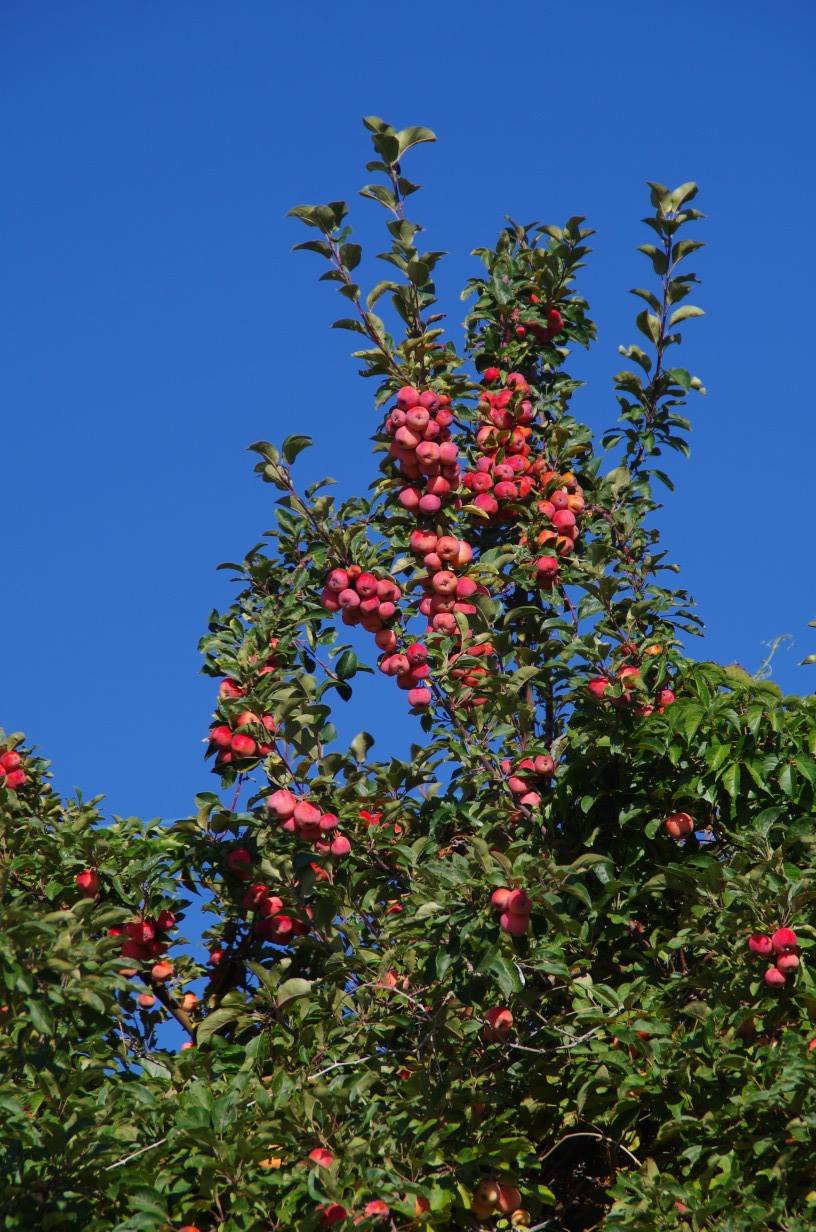
Crabapple for pectin.

  • Wash, remove bug-eaten sections.
  • Place in a large pot, water to ~80% volume of the apples.
  • Bring to boil, reduce to simmer, simmer for about an hour until apples are turn to mush.
  • Filter through a sieve, no filter, or food mill, or nut bag.
  • Use 1/4 volume of fruit and needs plenty of sugar.
Mango
  • 4 mangoes
  • 1 apple, core and chop (pectin), the peel supplies the pectin so dice well.
  • 1 lime (pectin and acid)
  • 1 cup of sugar
  • Bring to boil, mash
  • Did not set but was tasty and ready for mango lassi.


  • 6 mangos, 2 apples(grany smith) , 1 lime, 1 cup of sugar
  • dice the apples whole, add water to ~80%, bring to boil, simmer until soft, strain through colander
  • peel and dice mangoes, macerate with sugar.
  • bring to boil, simmer until mango falls apart,
  • add pectin liquid, lime juice,  bring to boil, and simmer.
Peach Jam
  • 3 lbs. or 7 medium peaches
  • 1 package of pectin
  • 2 Tbs lemon juice, or 1 lime
  • 5 C of sugar
  • 1/2 tsp cinnamon or allspice
  1. Peal, pit, dice peaches.
  2. Add pectin, sugar, acid, spice and macerate.
  3. Slowly bring to boil.
  4. Bring to a rolling boil to set point.
Set temperature= 104~105.5°C or 217~222°F
  • 101°C worked as well. The boiling surface changes at this temperature, it appeared more bubly
  • Altitude adjustment: 500 feet 1°F down, 4500 feet 11°F thus 209°F.
  • 205°F for pear jam seemed to become very viscous
  • 220°F for crabapple jelly was too hard, almost like rubber.  1 cup crabapple pectin + 1/4 C sugar.
Strawberries and rhubarb
  • 1 package strawberries, 2~3 stalks rhubarb
  • Remove stems from strawberries. Cut rhubarb into 1 inch. Add sugar to draw out liquid (~ 1 cup). Add salt.
  • 2 packs strawberry, 6 stalks (at least 2 cups after chopping), 1 C sugar, 2 small jars of crab apple pectin. o/n maceration, rapid heat to boil, mid-high boiling.
Wild plum
  • Freeze. Heating in oven works but releases more tannin than freezing.
  • Mash trough colander to obtain pulp and juice
  • Add sugar, pectin, (acid:  not usually). Skip pectin for sauce.
  • Bring to boil
  • Inspiration
  • Plums from Patty and Dave’s
  • 1 lbs. boiled with small amounts of water
  • Mash with potato masher, strain through a mesh strainer
  • 1.5 C Plum juice, 1 C Crabapple pectin, 1C sugar
  • Boil until 104°C. It became viscous around 100°C.
  • It set when it was still warm.
  • Year two, started with grocery bag full of low hanging fruit 7/30.  Added water water and boiled through the cone coliander which yeiled 12C of juice (almost the the top of the shallow pot). Reduction, 12C juice, 8C sugar, 8C crabapple pectin. Too much liquid to boil in the big pot. Switched to simmering reduction in two parts. The first part set overnight at room temperature. Need to work on maceration or freeze thaw to reduce the amount of water added.
  • 2025 July 24. 1800g of plums. 40 minute freezer. Crushed to sieved china-cap. Juice and pulp was 1800 – 783 =  apx. 1000g. 600g sugar, 100ml crabapple pectin. Boiled and moved into jars.  Did not set to hard jam, more like thick sauce. (1000g plum puree, 650g sugar, 25g pectin, 15g lemon juice, ratio comes from this link).
塩たれ

Ingredients:T3 酒 T3 ミリン T1 砂糖 T2 醤油 2x5cm 昆布 Arbol chili 1 Lime juice. Method: Mix all ingredients, stand for 15 min to allow kelp to seep, boil to remove alchol. Notes: This sauce seem too sweet off the stove, but after 1/4 cabbage and 2 persian cucumbers for an hour the flavor settled nicely.

なし

Ingredients:

  • 4 1/2 C of Asian pear, peeled, cored, diced
  • 2 Tbs pectin
  • 1/4 C = 4Tbs = 2 limes
  • 7 1/2 C sugar
  • Smallish 2 oz per pear.
  • This was syrupy with solids.

Procedure:

  1. Core, peel, and dice pears.
  2. Add pectin, lime juice and sugar.
  3. Bring to boil


Spice mix

Subscribe to continue reading

Subscribe to get access to the rest of this post and other subscriber-only content.

Pressure cooker

Mirro unit, M-0534-II. Gasket, valve, pressure valve OK. After 6 months of use a steam leak developed. A new gasket did not fix the leak. Thus this pot was retired.

Farberware 6 qt purchased March 2022.  Everything cooks including Peruvian beans without steam leak.

Interesting notes from Farberware cook book
beans vol liquid soaked(min) dry(min) notes
Black eyed peas 2 3 3~5 9~11 2 min, soaked: soft
Chick peas 2 3 11~13 35~40 8 min, soaked, soft not mushy
Pinto Beans 2 4 4~6 24~28
Soy Beans 2 4 16~18 35~40
Kidney beans 2 4 6~8 22~27
Red beans 2 4 4~6 24~28
Navy beans 2 4 2~3 24~28
Great Northern beans 2 4 6~8 35~40
Barley 1 2.5 14~18
Wild rice 1 2 18~22
Observations for Farberware cooker:
Barley pearled no 0m, slow cool fully cooked and slightly crunchy wash with cold water to stop cooking
Black-eyed peas no soak   Om, slow cool fully cooked and peas intact
Chick peas: 2h soak 10m cook partially hydrated slightly crunchy further cooking in saag made the peas soft.
Chick peas: >5h soak 8m cook 2x expanded fully cooked and not mushy
Fava Bean Overnight 35 min Skin is tough but masheable.
Fava Bean skined dry 8m Complete mush
Favabean (light yellow from Rancho) no 0m Mashable

Do not overcook as these will clug the pressure valve.

Peruvian beans: dry 2, 10m cook No leaks 2 min: crunchy 10min: mushy
Peruvian beans: 1hr wet 0+2m. short soak, did not expand much 0min, still crunchy, 2nd 2min. starting to fall apart.
Red beans (Nicaraguan) dry 20min Done, slight crunch, intact.
Red beans 1h wet 8m Done, crisp intact
Small Red Beans 3h soak =20% popped. this is under soaked. 8 min 2x first 8min. mostly too hard under cooked, 2nd 8min. Most popped, still intact shape, eatable.
Samp and Beans 1C each 30 min no soak, onion, celery, carrots, garlic, bay water to mid point, toss the stock veggies
Soya beans: 1.5 Cups 16 min. Soaked 10h, 2x expansion Fully cooked not mushy.

Steam leaked from the pressure valve.

Wheat berries:

Pelted

1 cup,

>5 cups water

3 min cook Dry, +salt Fully cooked but not mushy.
Wheat berries: whole wheat 1 cup, >5  cups water 20 min cook Dry, +salt Fully cooked with texture

Pinto bean experiment: Old dry pinto beans 1 cup, how long to cook?

Experiment 1:

  1. Quick rinse. Water to 2 inch above the beans.
  2. Close the cooker and high heat to boil and to pressure until steam release. This takes about 10 minutes
  3. After the steam starts to release, timer set 25 min, reduce the heat to medium.
  4. Turn off the stove.
  5. Slow cool ~20 minutes later lock was off.
  6. Result: beans are mostly done with some beans that were still crunchy.

Experiment 2:

  • Medium heat 35 min.
  • This came out all done, not mushy yet.

Wheat berries and faro

  • 1 Cup, Soak, 10 min. x 2 slightly hard but eatable.
  • 1 Cup, 4 cups of water, 45 min.  blew off the top multiple times and burnt the bottom.
  • 1 Cup, dry, 30 min.  dried out and burnt at the bottom.
  • No pressure cooker procedure:
    • 1 Cup wheat berries, 4 Cups water, bring to boil
    • Reduced to simmer, (pressure cook pot mid – 2, open) 30 minutes.
    • This cooked fine with no mess and/or spill. Pressure cooker does not save cooking time with wheat berries.  The dark (Faro?) were slightly harder with scheme.

Current procedure.

  1. Soak 1.5 cups beans. > 3 hrs or when the beans are swollen about 2 fold.
  2. Rinse the beans and put water to about an inch above the beans. Pressure cook high until the whistle.
  3. Reduce to medium and cook for 10 min.
  4. Let it cool down on its own.
  5. Works: chick peas, pinto beans, soybeans, black-eyed peas (shorten cooking time).
  6. Fails: Peruvian beans

Notes:

  • Soaked chickpea (ON soak).  15 min. Very soft, starting to fall apart.
  • Peruvian beans. 6h soak, 10 min.  Too much water, lots of foam leaking out of the side and the pressure vent making a mess. Beans were nicely done. Same happened with 1.5 cups and inch of water. Is this due to these beans?
  • Another failure with Peruvian beans. 1.5 cups soaked for 2 hrs. Water an inch above.  These beans did not swell, did not boil over, did NOT COOK.
  • Old pinto beans 5h soak, 10 min. Water was an inch above the beans. When the pressure built up bubble/steam  released from pressure vent. 2 cups of beans too much?
  • 1.5 cup of soaked chick peas, water below halfway. Did not boil over. 10 min.
  • 1.5 cup, 10 min seems to work for cooking.  Keep the water below half way point.  This creates approximately 3.5 cups of beans.

Peruvian Beans and boiling over.

  • 1.5 cups of Peruvian beens and pinto beans were soaked in water > 6 hours.  Both beans swell to at least 2 fold.
  • The usual setup. Water to about inch above. Heat at high, 10 min. medium heat after the whistle.
  • Peruvian beans leaked liquid from one side of the pot and took a long time to reach pressure. Pinto beans did not leak and reached pressure quickly.
  • Peruvian beans were not releasing steam most of the time but cooked to nicely. Liquid level just below the beans.
  • Pinto beans were releasing steam for most of the 10 minutes except the last few minutes. Beans cooked nicely. Liquid level just above the beans.
  • One last Peruvian bean experiment. 1 cup of beans was soaked until it swelled by two fold. Water was added to 1 inch above the beans. Massive amounts of liquid boiled over from the side and took a long time to reach pressure. The beans cooked nicely except for the mess.

9780761168706_BeanByBean_App-BasicBeanery

9780761168706_BeanByBean_App-LuscLentils

9780761168706_BeanByBean_App-ConvTables

phusion passenger

phusion passenger standalone on macbook

after gem install @stuff.

.ruby-virsons  file fix

.ruby-gemset file fix

stuff and mstuff can be served from phusion passenger

bundle exec passenger start -d (-p 3001)

on konarunsfree.net server

stuffz

Gemfile was modified

gem “passenger”, “>= 5.0.25”, require: “phusion_passenger/rack_handler”

bundle install
bundle exec passenger start -p 3001 -d (this worked)

mstuff

git issue

  • bare repository, mstuff.git created on nikofly with git clone –bare
  • mstuff.git was copied onto konarunsfree.net
  • mstuff.git was cloned to mstuff directory
  • database file was copied into mstuff/db/….

rvm issues

  • .ruby-version file = now using ruby-2.2.5
  • .ruby-gemset = using default gemset for 2.2.5

bundler issue

  • Gemfile and Gemfile.lock were copied from stuffz
  • bundle install

to start the server:

  • bundle exec passenger  -p 3002 -d (this works)

labbook

Gemfile was modified

gem “passenger”, “>= 5.0.25”, require: “phusion_passenger/rack_handler”

bundle install
bundle exec passenger start -p 3001 -d (this worked)

instiki

gem install passenger

this installed passenger 6.0.4

Gemfile was modified

gem “passenger”, “>=5.0.25”, require: “phusion-passenger/rack_handler”

bundle install

bundler failed at “require:” statement.

STARTING SERVERS AFTER RESTART


Starting servers after restart:

ssh kona@konarunsfree.net
cd rails/instiki
./instiki -d

cd rails/labbook
bundle exec passenger start -p 3000 -d

cd rails/mstuff

bundle exec passenger start -p 3002 -d

cd rails/stuffz
bundle exec passenger start -p 3001 -d

Getting an old rails server to run

RVM rails configurations 5/18/2020

instiki

  • ruby-1.8.7-p371 ——- in  .ruby-versions file.
  • instiki——————-in .ruby-gemset file.
  • uses port 2500
  • ./instiki -d to activate

labbook

  • ruby-1.9.3-p374——— in  .ruby-versions file.
  • labbook——————-in .ruby-gemset file.
  • uses port 3000
  • rails server -d to activate

stuffz: CD labstuff

  • ruby-2.2.5 —————-in .ruby-versions file.
  • default gemset.
  • rails server -p 3001 -d

Starting servers after restart:

ssh kona@konarunsfree.net
cd rails/instiki
./instiki -d

cd rails/labbook
rails server -d

cd rails/stuffz
rails server -p 3001 -d


A rails server, stuff,  that was running normally on two Macs was very difficult to run on linode server.

This is what finally worked.

Clean install ruby 2.2.5 with openssl support

  1. sudo apt-get purge libssl
  2. sudo apt-get install libssl-dev
  3. rvm install 2.2.5 –autolibs=disable
  • –with-openssl-dir=/usr/bin/openssl  did not work despite openssl version 1.0.1t

Change items in Gemfile.lock

  1. cd into stuffz directory
  2. rvm use 2.2.5
  3. edit the two items in Gemfile.lock
    1. json 1.8.1
    2. sqlite 1.3.9
  4. bundle install
  • This makes the server run with no data.
  • json 1.8.0 and sqlite 1.3.8 did not work, this was also the case with niko-air.

Rake to put the data in the database.

  1. edit Gemfile.lock: rake 10.14.2
  2. bundle install
  3. rake db:migrate
  4. cp the database file into db directory
  • Now the rails server runs with data!
  • The rake version in the old Gemfile.lock did not work.

On the mac, this server runs on ruby 2.0.0 and ruby 2.2.5 but not on 2.5.3.  On 2.5.3 json v=2.1.0 because v=1.8.1 would not build. Rails server starts but internal server error (500) and cannot see any data.

Ricotta notes

Uses

Ricotta cookie

Attempt 1. It came out nice following the recipe from Seriouseats.

Attempt 2. These came out very flat. Ingredients: 1 stick of butter, 1C brown sugar, 2t  baking powder, 1t sweet spice mix, ~ 1C ricotta (very stiff after o/n draining in the fridge), 1C flour (King arthur, bread flower), 2 lime zest, 1 lime juice. 350°F 7min x 2. This came out very flat and brown.  So many differences from the first time; did not chill the dough, baking powder, bread flower, brown sugar,  spice mix, lime zest and lime juice.

Lime flavoured ricotta sauce

Ingredients: 1.5 C ricotta, 1C cotija, 1 lime zeste, 1 lime juice, 1/2t salt, 1/2 black pepper, 1/2 C basil.

Making, Latest

Bring 1 Gallon of milk (any) to boil, turn off heat, and gently stir in 1/2 C of white vineagar. Curdles form instantly and yellow whey separates out. Collect the curds into a strainer with a slotted spoon. I can’t smell the dreaded vineagar and this seems to be the simplest and fail proof (Spring 2024)

1/4 C did curdled locally. No residue flavor or smell, so reducing and switching acid is probably not necessary. Adding salt before the vineagar might be an option here.

Recipe based on the one at Food lab.
1 gallon, 1 cup vinegar
heat two units below medium.
40~53°C big curdled things
at 54°C these curds broke up.
turned off heat
resumed heating to 74°C, this was total bust.

1 gallon, 1 cup vinegar
heat two units below medium
40°C big curds, harvested yielding wet cheese 1 quart.
filterate, reheated to 52°C, medium curds and fines, did not drain o/n on towel.
residue heated to 90°C, superfine curds.

Contrast this to yogurt.
Milk is heated to 90°C.
Cooled to 55°C and the starter added.
Sets fine in 4~18 hrs, not really acidic and whey does not separate.
Whey separates after about 30~48 hours with increased acidity.
At 8 hrs, it is probably down to room temperature.

What is the heat transition?
My ricotta adventure has been frustrating. I’ve tried three acids, lime juice, citrate, and vinegar. Your recipe has the highest concentration of acid and I get the most reliable curdling. The problem is that my best curdling happens between 40°C ~ 50°C, and does not go to completion. And at 53°C, there is a sharp transition and the curds disappear and turn into micro curds (superfine precipitate). This has happened 5 times so far. In the last batch, I took out the 40°C-curds and drained them yielding 1 quart from a gallon of milk. The remaining milk is still white. Further heating only produced the micro curds. I’ve not found anyone talk about this temperature and curd collapse. Do you think this altitude related? I’m at 5000 feet in Salt Lake City.
My alternative explanation is that the denaturation by heat and acid is different and the acid first method creates a sharp transition. This is based on my yogurt making experience. I heat a gallon of milk to 90°C, cool it to 55°C, and mix in 1/4~1/2 cup of starter yogurt. I get good setting (curdling) in about 4~8 hours. In acid terms this is nowhere near the 1 cup of vinegar in your recipe. The 4~24 hour yogurt is not tart and whey separation only starts after 30 hours.

With these two observations, I reversed the heat and acid steps. Milk was heated to 90°C (just below boiling here at SLC) with the burner set on high (5 minutes). This was cooled to 53°C (thermometer set on alarm). I mixed in 1 cup of vinegar. The milk curdled beautifully in seconds with a clear yellow whey separating. I scooped out most of the curds with a slotted spoon and drained it over paper towels over a colander.

Now I have more questions questions.
Is cooling necessary?  Cooling was not necessary. Vinegar added to boiling milk at 94°C produced curds instantaneously.
How high does the preheating need to go?
Can I add less acid?

I like the idea of the microwave but I can’t do 1 gallon batches, my microwave hanging at my eye level and I don’t like the thought of lifting a gallon of hot liquid above my head.

Another failed attempt 4 years later.:

1 Gallon of milk heated to 79°C, and added 1/3 cup (75.7 ml) of vinegar.  This did not curdle well.  Reheated to 85°C which created small curds,  obtained 1 quart with mostly milky liquid. No acid flavor but milky and bland. This recipe was at serious eats and by Dan G.

Further tweaks 2/22/21:

Milk to 86°C, burner high and shutoff, the temperature went to 92°C. Added 1/2 cup of vinegar. Let it sit for ~20 minutes.  This procedure curdled well with large yield and clear yellow whey. Scooped out large curds with slotted spoon and drained it on colander with coffee filter.

More failure 4/23/21:

This attempt was based on Amish Melting Cheese Recipe. 1 gallon of milk heated to 140°F (60°C) and add 2 table spoons of citric acid. This was modified as follows and did not produce curds.

  • Heated to 70°C and citric acid added: no curds.
  • Heated to 85°C: no curds.
  • Added 1/2 cup acetic acid: no curds.
  • Cooled to 55°C and added yogurt: Separation after > 6hrs.
  • It appears the milk has to be heated to 90°C before addition of acid. Fermentation appears to work by a different mechanism.

Partial failure 6/9/21

Milk was heated to 87°C, taken off the burner. 1/3 cup of vinegar. Curds formed partially whey is still cloudy. Can’t tell if this is not enough heat or not enough acid.


Crabapple pudding

crabapple

This evolved from an recipe for a Cherry Pudding.

This recipe works with any fruit that is on the sour side. I’ve tried it with sour cherry, apricot, rhubarb, cranberry, and crabapple.  Pitting cherries is a pain. Pitting apricots is the easiest. Coring crabapples is somewhere in between.  Crabapples are free and it feels better than throwing them away.

The crabapples:

Core crabapples leaving the skin on and just cutting four sides.  Put the crabapples in a pot, sprinkle sugar and cinnamon to draw out the liquid. Let this happen while you core the crabapples.  Add enough sugar to draw out the liquid. You can add more sugar after cooking to suit your taste. Cover and cook until liquid comes to a slow boil but stop before it completely turns into soup.

The cake base:  mix

  • 1/2 cup butter, melted
  • 1 cup sugar
  • 1 1/2 teaspoon baking powder
  • 1/4 teaspoon salt
  • 1 egg
  • 1 cup milk
  • 1 1/2 cups all-purpose flour
  • 1 teaspoon vanilla.

Pour into a baking dish (10 x 10). Pour the crabapples, > 2.5 cups or as much as you like, over the cake base.  Bake at 350°F for 45~55 min.

Variations: Milk (coconut milk, yogurt, half and half) Flour (whole wheat) Fruit (sour cherry, rhubarb, cranberry, apricot, crabapple)

These crabapples make a wonderful crisp.